
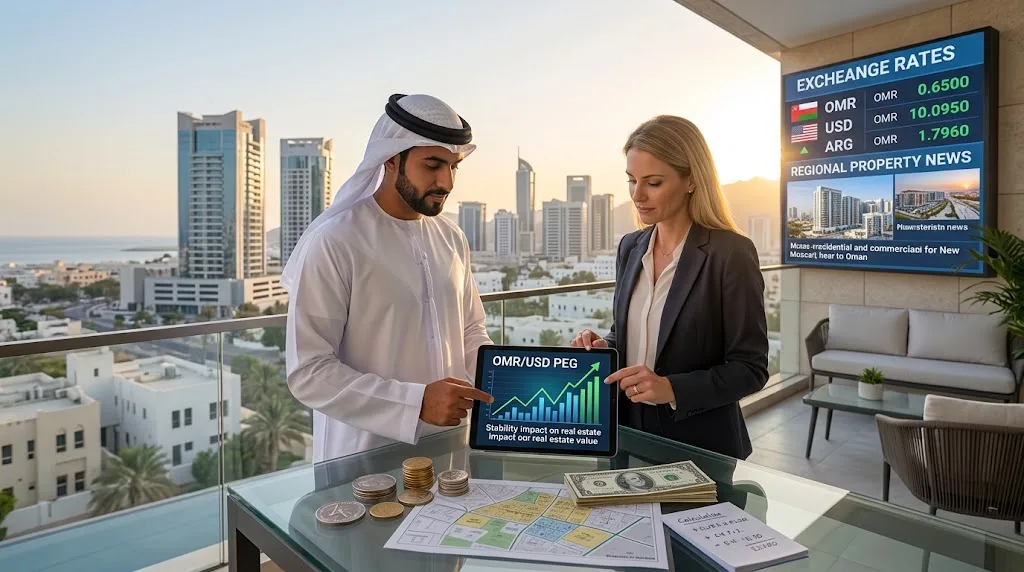
A detail that rarely makes it into a Muscat property brochure, but matters more than almost anything else in the deal for a foreign buyer, is that the Omani rial has been fixed to the US dollar at the same rate since 1986. That fact quietly does a lot of work in de-risking a purchase, and it also gets overstated in ways worth correcting.
The mechanics, briefly#
The Central Bank of Oman pegs the rial at approximately OMR 0.3845 to USD 1, a rate unchanged since 1986. That makes the rial one of the highest-valued currencies in the world in nominal terms, which is really just an artifact of where the peg was originally set rather than a sign of anything else. The peg has survived the 1990s, the 2008 financial crisis, and two sharp oil price collapses in 2014-2016 and 2020, periods when a floating currency tied to an oil-dependent economy would typically have come under real pressure.
What it protects you from#
If you are a dollar-based buyer, whether resident in the US or simply holding dollars, and you buy a property priced in OMR, the peg means your investment does not gain or lose value against the dollar purely from currency movement. An OMR 150,000 apartment is worth USD 390,000 today and will be worth USD 390,000 in dollar terms in five years regardless of what happens to the rial's nominal value, because nothing happens to it. Compare that to a market with a floating currency, where a strong local property return can be partly or wholly erased by currency depreciation by the time you convert proceeds back to dollars, or conversely amplified by currency appreciation. Oman removes that variable entirely for a dollar-denominated buyer.
This is also why the peg makes Oman directly comparable, at least on currency terms, to its GCC neighbors. The UAE dirham, Saudi riyal and Qatari riyal are all pegged to the dollar too, which is one of the reasons our Oman versus Dubai and Oman versus Saudi and Bahrain comparisons can focus on market fundamentals rather than currency forecasting. Kuwait is the regional exception, pegging its dinar to a basket rather than the dollar alone.
What it does not protect you from#
Here is where the peg gets oversold. If your own base currency is not the dollar, you still carry currency risk, just relocated one step. A UK-based buyer converting GBP to OMR is exposed to GBP/USD movement, since OMR simply tracks the dollar. The same applies to EUR, INR, or any other non-pegged currency. The peg fixes the OMR/USD leg of the trade; it does nothing about the leg between your own currency and the dollar.
It is worth being precise about this distinction because "Oman's currency is stable" is sometimes used as shorthand for "this investment carries no currency risk," and that is only true if you are already thinking in dollars.
The interest rate consequence#
The less obvious effect of the peg shows up in mortgage pricing rather than in the exchange rate itself. To defend a fixed peg, the Central Bank of Oman's policy rate generally has to track the US Federal Reserve's rate rather than move independently to suit Oman's own domestic conditions. That is why Omani mortgage rates climbed through 2022 and 2023 alongside the Fed's hiking cycle, a pattern our mortgage guide covers in more detail. A borrower financing a purchase in Oman is, in effect, exposed to US rate policy even though the loan is denominated entirely in rial.
Durability of the peg#
No currency peg carries a zero-probability guarantee of lasting forever, and it would be wrong to claim otherwise. What can be said is that the Oman peg has now held for close to four decades across multiple severe oil price shocks, it sits alongside the same dollar-peg policy every other major GCC economy except Kuwait has chosen to maintain, and no GCC state has depegged from the dollar since these arrangements were established. That is a meaningfully different risk profile from a currency with a shorter track record or a history of managed devaluations.
What to do with this#
If you are a dollar-based investor, the peg is a genuine and durable advantage that removes one entire layer of risk other emerging property markets carry. If you are not dollar-based, model your actual exposure against your own home currency's movement versus the dollar rather than assuming the OMR peg covers you completely. And when comparing Oman to other GCC markets, remember the currency question is largely already answered the same way across the region, so the differentiators that actually matter are liquidity, yield and regulatory depth, which is where our best areas to invest guide is more useful than any currency analysis.
Run the numbers on a specific property with the mortgage calculator, or use the AI Property Advisor to think through financing in the context of your own home currency.
Sources: Central Bank of Oman exchange rate policy, OMR/USD peg at approximately 0.3845 maintained since 1986; GCC currency peg arrangements against the US dollar, with Kuwait's basket-peg exception. Exchange rate policy is a matter of sovereign monetary policy and can in principle change; this is general information rather than financial advice, so confirm current policy with the Central Bank of Oman and your own financial adviser before making currency-sensitive decisions. Property figures per our methodology.