
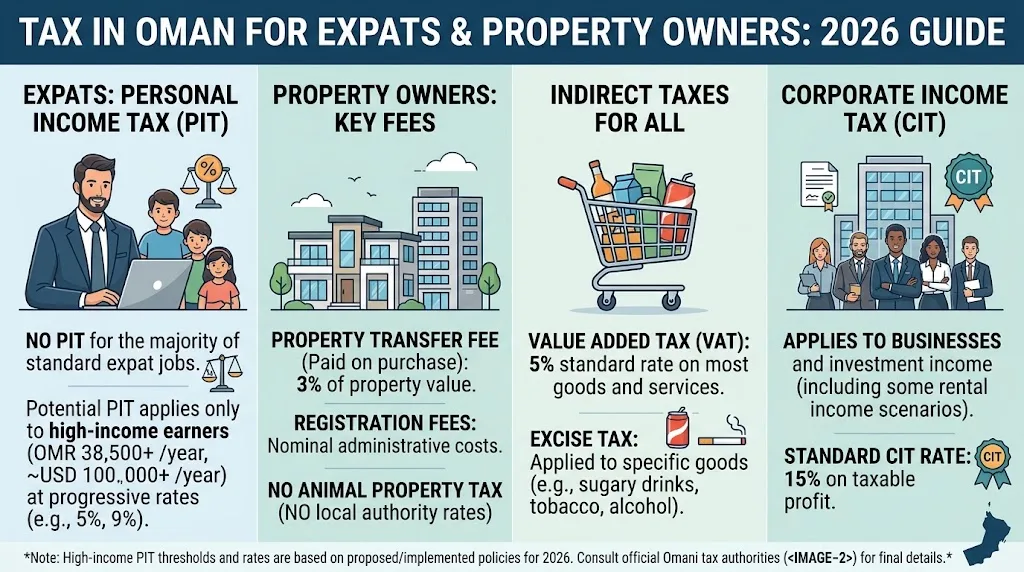
Oman's tax position is one of the genuinely strong parts of the investment case, and it is also the part most often described loosely. "Tax free" is close to accurate for an individual owner in 2026, but not exactly accurate, and the gap between those two things is where budgets go wrong. Below is the full picture: what applies to you today as an owner or an expat resident, what is coming in 2028, and which costs people wrongly file under "tax" when they are really something else.
The headline position in 2026#
| Tax | Applies to an individual property owner? | Rate |
|---|---|---|
| Personal income tax | No, until 1 Jan 2028 | 0% now, then 5% above OMR 42,000 |
| Annual property tax | No | None |
| Capital gains tax on residential sale | No | None |
| Inheritance tax | No | None |
| Municipality tax on residential rent | Yes, if you let the property | 3% of gross rent |
| VAT on first sale of new residential property | Yes, on developer sales | 5% |
| VAT on residential rent | No, exempt if registered and 3 months or longer | 0% |
| Registration fee at title transfer | Yes, paid by the buyer | 3% of price |
Two of those lines carry most of the practical weight for an investor, so they are worth taking slowly.
The 3% municipality tax is the one people forget#
If you buy in an ITC community and let the unit out, your gross rent is not your income. A municipality tax of 3% on gross rental income applies, and the tenancy contract itself has to be registered with the relevant municipality. This is small in isolation, which is exactly why it drops out of spreadsheets, but it stacks with service charges and any management fee to move a gross yield noticeably.
Take a unit at Al Mouj let at OMR 900 a month. Gross rent is OMR 10,800 a year, and the 3% municipality tax takes OMR 324 of it before you have paid a single service charge. That is not a reason to avoid letting property in Oman. It is a reason to underwrite on net rather than gross, which is what our yield calculator does by default and what most listing site yield claims do not.
What VAT does and does not touch#
Oman applies VAT at 5%, and its treatment of real estate has a clean logic once you see the pattern. The first sale of residential property built by a professional developer is taxable, so a new off-plan unit bought from a developer carries VAT. Sales between individuals in the resale market, and residential rentals, are treated as exempt.
The practical consequence: VAT is a live question if you are buying off plan and largely irrelevant if you are buying resale or letting a home out. When you compare a developer's price against a resale comparable, check whether the developer figure is quoted inclusive or exclusive, because a 5% gap on an OMR 200,000 purchase is OMR 10,000 and it will not show up in a headline price-per-sqft comparison.
For a residential rental to sit in the exempt category, two conditions apply: the contract is registered with the competent authority such as Muscat Municipality, and it runs for at least three months. Short lets structured under three months therefore sit in different territory, which is worth checking carefully if your plan is a short-term rental operation rather than a standard annual tenancy.
The 2028 personal income tax law#
Oman signed a Personal Income Tax law in June 2025 with effect from 1 January 2028. The structure as announced is a 5% flat rate on annual income above OMR 42,000, roughly USD 109,000. Executive Regulations setting out the filing mechanics were expected during 2026.
Three things follow from that for a property investor.
First, the threshold is high relative to typical rental income from one or two units. A single ITC apartment generating OMR 10,000 to OMR 15,000 a year does not approach OMR 42,000 on its own, and the rate above the threshold is 5%, not a progressive band structure.
Second, the law introduces individual filing where none existed. Even where the tax due is zero, the administrative habit of documenting rental income properly is worth starting now rather than in December 2027. Keep registered tenancy contracts, bank records of rent received and invoices for deductible costs in one place from the start.
Third, the detail that matters most, which is how rental income is defined and what can be set against it, sits in the Executive Regulations rather than in the headline law. Anyone underwriting a portfolio on the assumption that Oman stays at zero forever should model the 2028 change instead, and anyone alarmed by it should check their actual numbers against a OMR 42,000 threshold first.
Costs that are not taxes, but hit like them#
Three recurring items get filed under "tax" in conversation and are not:
Service charges. Community charges in ITC developments are set by the community and vary meaningfully between them. They are the largest recurring cost for most owners and are covered in our hidden costs guide.
The 3% registration fee. Paid once, by the buyer, at title transfer through the Ministry of Housing and Urban Planning. It is a transaction fee rather than a tax on ownership, and it does not recur.
Agency commission. Typically around 2% on a sale, borne by the seller. Also not a tax, and also not optional in practice for most sellers given the market's limited public transaction data.
How Oman compares in the region#
The comparison people reach for is Dubai, and on pure tax the two are close. Neither charges personal income tax on individuals in 2026, neither taxes capital gains on residential property, and both charge a transfer fee at registration (3% in Oman, 4% in Dubai). Oman's coming 2028 personal income tax introduces a difference the UAE currently does not have, though only above a high threshold.
Tax is rarely the deciding variable between the two anyway. Liquidity, transaction volume and data transparency are, and on those our Oman versus Dubai comparison is a good deal more useful than a tax table.
What to do with this#
If you own or are buying to let, budget the 3% municipality tax explicitly, register the tenancy contract, and confirm whether a new-build price is VAT inclusive. If you are a resident earning above OMR 42,000, watch for the Executive Regulations ahead of 2028 rather than acting on the headline rate alone. If you are comparing Oman against another market on tax alone, the honest answer is that the difference is smaller than the difference in market depth.
Run a specific unit through our yield calculator to see the net figure after fees, or use the AI Property Advisor to compare communities against your own budget.
Sources: Oman Personal Income Tax law signed June 2025, effective 1 January 2028, 5% above OMR 42,000; Oman Tax Authority VAT guidance on the real estate sector, covering the residential rental exemption conditional on registration and a minimum three month term, and the taxable first supply of residential property by a developer at 5%; 3% municipality tax on gross residential rental income; 3% property transfer fee payable at Ministry of Housing and Urban Planning registration. Tax law changes, and this is general information rather than tax advice, so confirm your own position with a qualified adviser. Property figures per our methodology.