
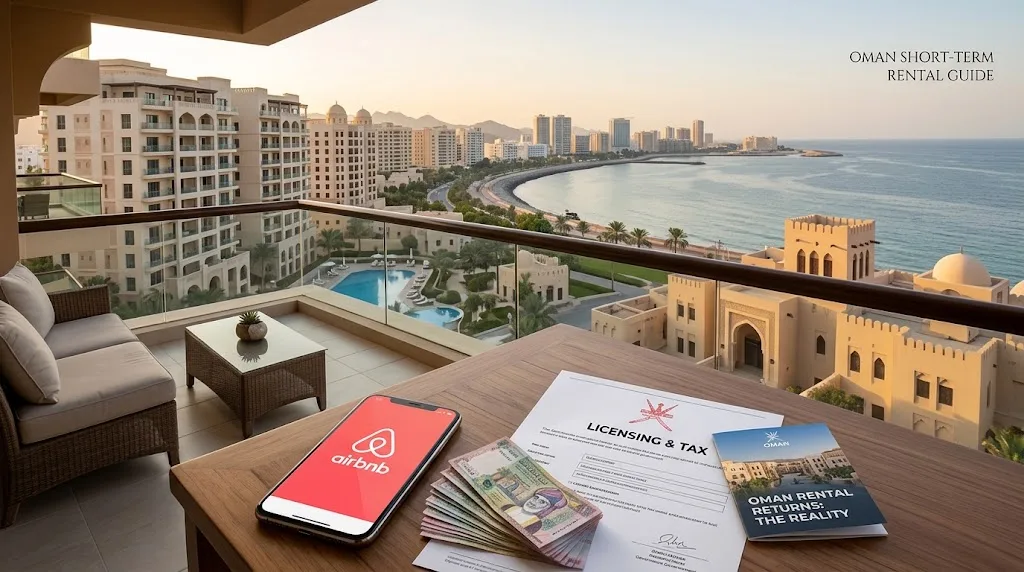
Short-term rental is pitched constantly as the way to lift an Omani property's return above what a long lease pays. The licensing side of that pitch is usually thin, and the returns side is usually wrong.
Here's both, with the numbers that actually get reported rather than the ones in the brochure.
It's a licensed activity, not a side hustle#
Oman does not ban short-term rentals. It regulates them as tourism accommodation, which is a different thing from the permissive grey zone hosts sometimes assume.
The framework sits under the Tourism Law, Royal Decree 69/2023. In practice:
- You need a tourism-accommodation activity licence from the Ministry of Heritage and Tourism (MHT), applied for through the government portal.
- A ministerial circular requires the licence number to be displayed on all listings.
- Reported licence fees run roughly OMR 250–800, with the final figure depending on the category assigned to your property.
- Applications are reviewed within around 60 days under 2026 procedures.
- Tourism regulations updated in 2026 gave existing operators a six-month compliance window, covering hotels and tourist establishments alongside travel agencies, tour guides and other tourism businesses.
Two things this framework does not impose, which is worth knowing because both exist in other markets:
- No national night cap. No 90- or 120-night annual limit was identified.
- No owner-occupancy requirement. A secondary property can be let short-term.
Where you can actually do it#
Restrictions bite at the building, not the district. There's no neighbourhood-level ban, but:
- Owners' associations and managed compounds can prohibit short-term letting outright, and in Oman's premium ITC communities this is common. The new Real Estate Regulation Law (Royal Decree 79/2025, in force March 2026) formally gives owners' associations legal personality and ministerial supervision, which strengthens rather than weakens their rulemaking.
- Municipality position on the specific property matters.
- If you're a foreign buyer, the property has to be in a licensed Integrated Tourism Complex to begin with — the same restriction that governs ownership generally. See our freehold and ITC guide.
Check the building's rules before buying a unit on a short-term rental thesis. Community rules override your plans, and this is the single most common way a short-term rental strategy dies before it starts.
The returns, honestly#
This is the section that tends to be missing. Reported 2026 figures for the Omani market:
| Metric | Muscat | Salalah |
|---|---|---|
| Average nightly rate | ~OMR 45 | Higher, strongly seasonal |
| Average occupancy | ~30–34% | Strong June–September (Khareef) |
| Monthly revenue | OMR 230–280 | Peaks OMR 400–900 |
| Monthly expenses | OMR 130–650 | Varies by property |
| Typical net monthly | −OMR 50 to +OMR 180 | Highly seasonal |
And the number that frames all of it: break-even occupancy typically runs 28–38%, against an average Muscat occupancy of 30–34%.
Read that twice. The average Muscat short-term listing operates at approximately break-even. Most listings run net margins between 0% and 35%. Top hosts reach 55–75% occupancy — that's a genuine gap, and it's a gap in operating skill, pricing discipline and listing quality, not in property selection.
Also note the OMR 45 average nightly rate against Muscat's long-term rents: a two-bedroom in Muscat Hills lets for around OMR 490 a month with essentially no operating effort. At 32% occupancy and OMR 45 a night, a short-term listing grosses roughly OMR 430 a month — before cleaning, utilities, platform fees, the licence, and the 4% tourism tax. The long lease wins comfortably at average performance.
The tax side#
- 4% tourism tax applies to licensed hotel establishments, and licensed hosts should budget for it.
- VAT applies once the activity crosses the registration threshold.
- 3% municipal tax on gross rental income applies to rental income generally.
- There is still no annual property tax and no personal income tax in Oman in 2026, though a personal income tax has been announced for 2028.
Layered onto thin margins, these matter more than they would on a long lease.
Where short-term genuinely works#
Three situations where the case is real rather than aspirational:
1. Salalah during the Khareef. Dhofar's monsoon season, roughly June to September, produces a demand spike that has no equivalent elsewhere in the Gulf — a green, cool, rainy season that draws heavy regional tourism. Hawana Salalah, Oman's largest beachfront resort ITC, is built around exactly that pattern, and we track it at an estimated 6.5% yield with a 40% off-plan share. A property whose entire year is made in four months is a different business from a Muscat listing grinding at 32% occupancy, and it is genuinely seasonal rather than year-round.
2. Heritage and waterfront tourism locations. Muttrah's corniche and souq area draws cultural tourism that the residential districts don't.
3. Operators, not owners. If you'll actively manage pricing, turnover, listing quality and reviews — or pay someone competent to — the 55–75% occupancy band is reachable, and at that level the economics change completely. If you want passive income, this is the wrong product.
What to do before committing#
- Confirm the building permits it. Owners' association rules first, everything else second.
- Confirm the property can be foreign-owned — licensed ITC status, in writing.
- Price the licence and the 60-day review into your timeline and budget.
- Model at 32% occupancy, not 65%. If it doesn't work at the market average, you're betting on being an above-average operator from a standing start.
- Compare against the long-let alternative properly. Run the same property through our yield calculator as a long-term let, with service charges included, and compare net against net.
The honest summary: short-term rental in Oman is legal, licensable, and workable — but at market-average performance it does not beat a long lease in a decent mid-market area, and the areas with the best long-let yields we track (Al Khuwair and Al Khoud, at an estimated 7.5%) do so with none of the licensing, turnover or seasonality risk.
Sources: Tourism Law (Royal Decree 69/2023) and MHT licensing requirements; 2026 Omani tourism regulation updates as reported in the national and trade press; our Oman short-term rental analysis (updated July 2026) for occupancy, nightly rate, expense and net-margin ranges; Royal Decree 79/2025 on owners' associations. Yield and off-plan figures from our own area dataset — see our methodology. Licence fees and categories are as reported and can change; confirm with the Ministry of Heritage and Tourism directly.