
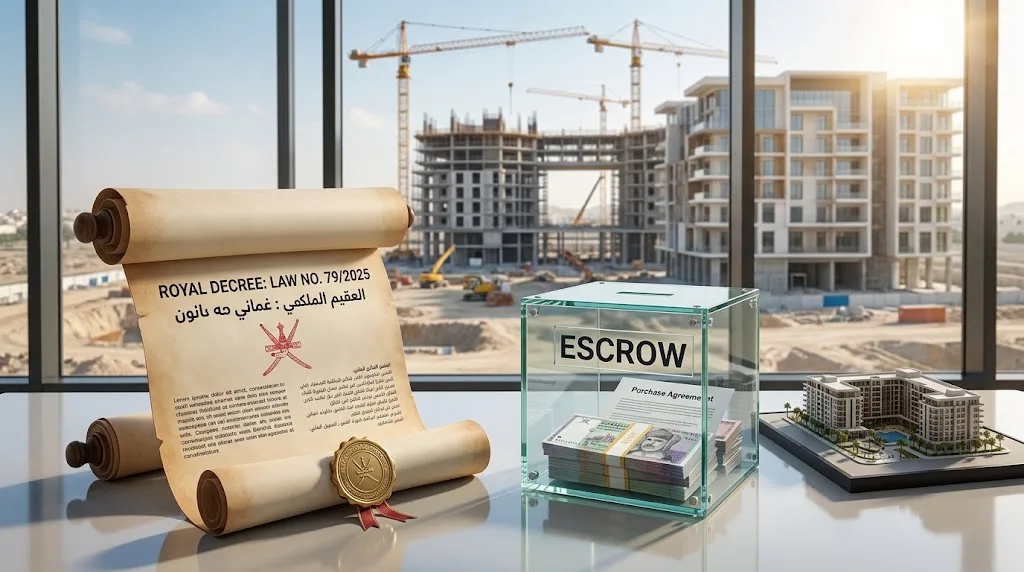
Off-plan is how a large share of Oman's freehold stock is sold, and the pitch is consistent: lower entry price, staged payments, appreciation between contract and handover. What's usually missing from that pitch is the legal machinery underneath it — which, as of March 2026, changed.
What changed on 10 March 2026#
Royal Decree 79/2025, the Real Estate Regulation Law, came into force on 10 March 2026. It's a consolidation rather than a tweak: it repeals and replaces three separate laws that had governed different corners of the sector for decades.
| Repealed | What it covered |
|---|---|
| Royal Decree 78/86 | Real estate brokerage regulation |
| Royal Decree 48/89 | Ownership of apartments and floors |
| Royal Decree 30/2018 | Escrow accounts for real estate development projects |
What the consolidated law puts in place:
- Developer licensing must be obtained before a project proceeds.
- Independent escrow accounts for buyer payments, with withdrawals restricted to approved construction phases.
- Financial guarantees for project completion.
- Contract registration in the real estate register.
- Broker licensing through the Ministry of Housing and Urban Planning, with mandatory registration in a national sector registry and stated obligations of integrity, transparency and client-interest protection.
- Owners' associations for jointly owned property, given legal personality and placed under ministerial supervision.
- Administrative and criminal penalties, including fines and licence revocation.
There's also a deadline worth knowing about: developers must register all subdivided units in off-plan projects, and prior dispositions, within six months of the law taking effect — putting that deadline around 10 September 2026. If you hold an off-plan unit bought before March 2026, this is a reasonable moment to ask your developer directly whether your unit's registration has been completed.
Executive bylaws implementing the law are anticipated but had not been published in detail at the time of writing. As with the Real Estate Registry Law 56/2026, the framework can be in force while the operational detail is still landing — worth confirming the current position rather than assuming.
How escrow actually protects you#
The escrow mechanism, carried forward from the 2018 law into the new framework, is the substantive protection in an Omani off-plan purchase. It works like this:
- The developer opens an escrow account at a local bank, in the project's name. Each project gets its own — funds can't be pooled across a developer's portfolio.
- Your payments go into that account, not to the developer.
- To withdraw, the developer submits an application accompanied by certification from the project consultant verifying the work the withdrawal corresponds to.
- 5% of the sales value is retained for one year from registration, as a defect and completion backstop.
- Advertising spend from buyer funds is capped at 3% of amounts deposited, and requires prior ministry approval.
- The developer must provide the ministry with quarterly bank statements for the account and keep records for five years after closure.
That's a real framework, and it addresses the failure mode that has damaged off-plan buyers in other markets: money from Project B funding the completion of Project A.
What escrow does not protect you from#
This is the part the marketing doesn't cover, and it's where off-plan risk actually lives in Oman.
Delay. Escrow controls where your money sits. It does not make a project finish on time. Construction timelines in the region routinely slip, and a two-year delay on a unit you bought for rental income is two years of returns you don't get.
Specification drift. Your protection is what's written in the Sale and Purchase Agreement, not what was in the render. Finishes, layouts, common amenities and the phasing of shared facilities — pools, gyms, retail — are frequently delivered later or differently than shown.
A thin resale market. This is the risk most specific to Oman. Foreign ownership is confined to licensed ITC zones, which means the pool of buyers who can purchase your unit from you is structurally small. If your plan is to flip before handover, understand that you're selling into a narrow market. Our Oman vs Dubai comparison covers the liquidity gap in detail.
Yield assumptions. Off-plan projections in marketing material are projections. The gross yields we track across Muscat's freehold-eligible areas run from an estimated 5.2% at Al Mouj to 7.0% at Muscat Bay — useful as a reality check against any brochure number, and worth running properly through our yield calculator with the actual service charges included.
The questions to ask before signing#
Take these to the developer, and get the answers in writing:
- Is the project licensed, and can I see the escrow account details? Both are legal requirements. A developer unwilling to evidence them is telling you something.
- Is this development a licensed ITC? This determines whether you can own it at all as a foreigner. "Freehold" in a brochure is marketing language; ITC status is a legal designation under Royal Decree 12/2006.
- Has my unit been registered under the 79/2025 six-month requirement? Relevant for anything bought before March 2026.
- What is the exact payment schedule, and what triggers each instalment? Construction milestones, not calendar dates, is the structure you want.
- What happens if delivery is late? Look for a specific remedy in the SPA — compensation, penalty, or termination right. "The developer will use reasonable endeavours" is not a remedy.
- Is the title freehold or usufruct? Some ITC units are granted as long-term usufruct rather than full freehold. Both are workable; they are not the same thing. Detail in our freehold and ITC guide.
- What are the projected service charges at handover? These come off your yield every year, and premium ITC communities are not cheap to run.
Have a licensed Omani conveyancer review the SPA before signing, not after. The payment schedule and the late-delivery clause are the two terms most worth spending money to get reviewed.
Off-plan and residency#
One genuine advantage worth knowing: the Owner's Residence Permit introduced by Royal Oman Police Decision 87/2026 explicitly covers preliminary-registered property — off-plan units that aren't yet completed or fully registered. It has no stated minimum investment value, runs six months to a year at a time, is renewable, and extends to first-degree relatives.
That means an off-plan purchase can support a residency application before handover, which the higher-threshold Golden Residency route does not offer in the same way. The two programs are separate and have different terms — see our Oman golden visa guide for the full comparison.
Where off-plan is actually happening#
Off-plan share is one of the figures we track per area, and it's a useful read on where development activity is concentrated:
| Area | Off-plan share |
|---|---|
| Al Khoud | 40% |
| Hawana Salalah | 40% |
| Al Mouj | 35% |
| Muscat Bay | 35% |
| Muscat Hills | 30% |
| Qurum | 10% |
Qurum's 10% tells you it's a built-out, established district. Al Khoud's 40% tells you the Seeb corridor is where new supply is landing — reinforced by Sultan Haitham City nearby, which is adding roughly 20,000 homes over its build-out.
Browse current developments on our Oman projects pages, each with sourcing for its price, unit mix and payment plan.
Sources: Royal Decree 79/2025 (Real Estate Regulation Law, in force 10 March 2026); Royal Decree 30/2018 escrow law provisions; Royal Oman Police Decision 87/2026; Royal Decree 12/2006; and our own review of the published legal commentary on each. Off-plan share and yield figures from our own area dataset — see our methodology. Executive bylaws under 79/2025 were still pending at the time of writing; confirm the current operational position with a licensed conveyancer.