
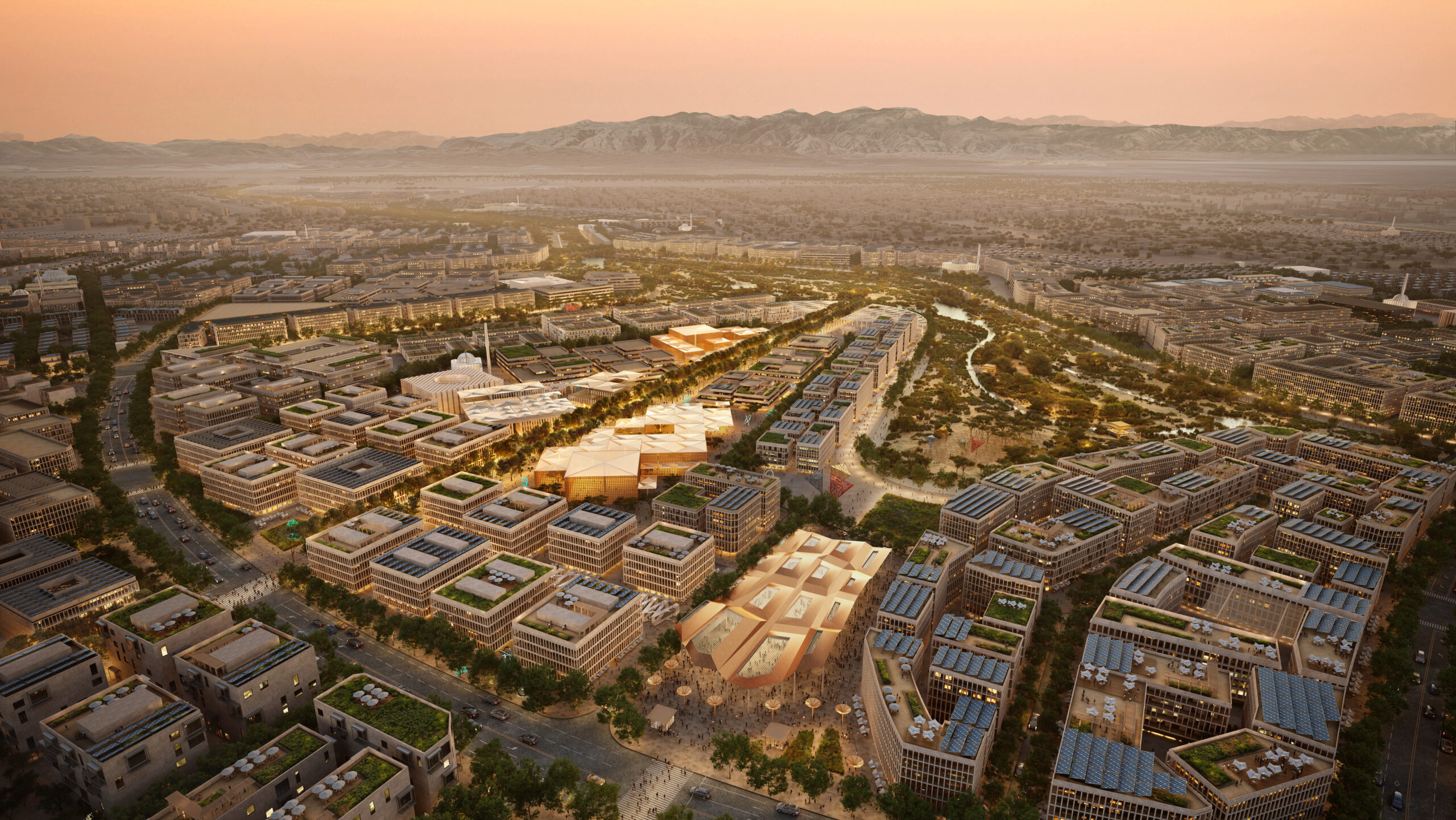
Sultan Haitham City is the largest single urban development Oman has undertaken in decades, and it's starting to show up in investor conversations well before most of it has actually been built. Here's what's real, what's still a plan, and what a buyer should treat with caution.
What Sultan Haitham City actually is#
Sultan Haitham City is a new master-planned city being built in Al Seeb, several kilometers west of central Muscat, covering roughly 14.8 square kilometers of what was previously undeveloped land. It's one of the flagship projects under Oman Vision 2040, the government's long-term economic diversification plan, and its master plan was designed by SOM (Skidmore, Owings & Merrill), the same international architecture firm behind large-scale urban projects elsewhere in the world. That's worth noting for anyone doing due diligence: this isn't a small private developer's off-plan tower, it's a state-backed city built from a professional master plan, with the design credibility that comes with it.
The plan calls for around 100,000 residents across 20,000 residential units, organized into 19 integrated neighborhoods. Public project overviews describe roughly 39 schools, 11 health facilities, and 25 mosques distributed across the city, alongside a central green spine built around a revitalized 7.5-kilometer wadi (a natural dry riverbed), with about 2.9 million square meters of parks and public space in total.
Timeline: four phases, running to 2045#
This is not a project that finishes next year, and treating it as one is the most common mistake in how it gets marketed. The plan is split into four overlapping phases:
- Phase 1: 2024 to 2030, roughly 6,700 units
- Phase 2: 2028 to 2034/2035, roughly 4,200 units
- Phase 3: 2033 to 2040, roughly 3,500 units
- Phase 4: 2038 to 2045, roughly 4,500 units
Only Phase 1 is currently under active construction. Public updates on the project have reported enabling works well underway, with the first model villa handovers targeted for around mid-2026, but treat any specific completion date as directional. Multi-decade infrastructure projects routinely shift their internal phase boundaries, and Sultan Haitham City has no delivery track record yet to benchmark against.
Can foreigners actually buy here?#
Oman restricts foreign freehold property ownership to specific government-licensed Integrated Tourism Complex (ITC) zones, a framework covered in more detail in our guide to buying property in Oman as an expat. Officials at the Ministry of Housing and Urban Planning have publicly stated that expatriates will be able to own property in select areas of Sultan Haitham City under this same ITC structure, and that qualifying purchases are expected to carry the same residency-linked benefits as other ITC developments.
The word "select" matters. Not every plot in a 20,000-unit city spanning four decades of construction will automatically carry ITC status on day one. Before reserving anything, confirm the specific building or plot's ITC status directly with the developer or the ministry, exactly as you would for any other Oman freehold purchase.
What this means for investors#
The case for Sultan Haitham City is mostly a case about Oman's broader direction, not about this project in isolation. It's a government-committed, professionally master-planned expansion of the capital, with real infrastructure, schools, and healthcare facilities designed in from the start rather than added later. Projects like this tend to pull public investment, transport links, and, eventually, private amenities toward them over time, which is part of why early buyers in comparable master-planned Gulf developments elsewhere have often done well over a long enough horizon.
That said, "master-planned government city" and "guaranteed good investment" are not the same claim, and the two get conflated constantly in how new Gulf megaprojects are marketed. Worth weighing against an already-established, liquid area, like the ones on our Muscat area pages, where years of actual pricing and rental data exist. Run any specific unit's numbers through our yield calculator using conservative, not marketed, rent assumptions before comparing the two.
What to watch before committing#
A few honest caveats, not sales talk:
- No resale history exists yet. Every yield or appreciation figure currently attached to this project is a projection from a developer or broker, not a verified transaction. Treat it accordingly.
- Off-plan payment risk applies here like anywhere else. Confirm escrow arrangements and payment milestones tied to actual construction progress, not just a sales calendar.
- Phase timing can move. A 2045 horizon on the final phase means Phase 3 and 4 buyers are underwriting execution risk over two decades, not two years.
- "Select areas" for foreign ownership is not the whole city. Get the ITC status of your specific unit confirmed in writing before you commit to anything.
Bottom line#
Sultan Haitham City is real, it's under construction, and it's backed by genuine government commitment and a credible master plan, which is more than most new-city announcements in the region can say. But it's still an early, multi-decade project with no delivered inventory or resale data to verify against. If you're considering it, treat it as a long-horizon, higher-risk allocation next to established areas, not a like-for-like substitute for one.