
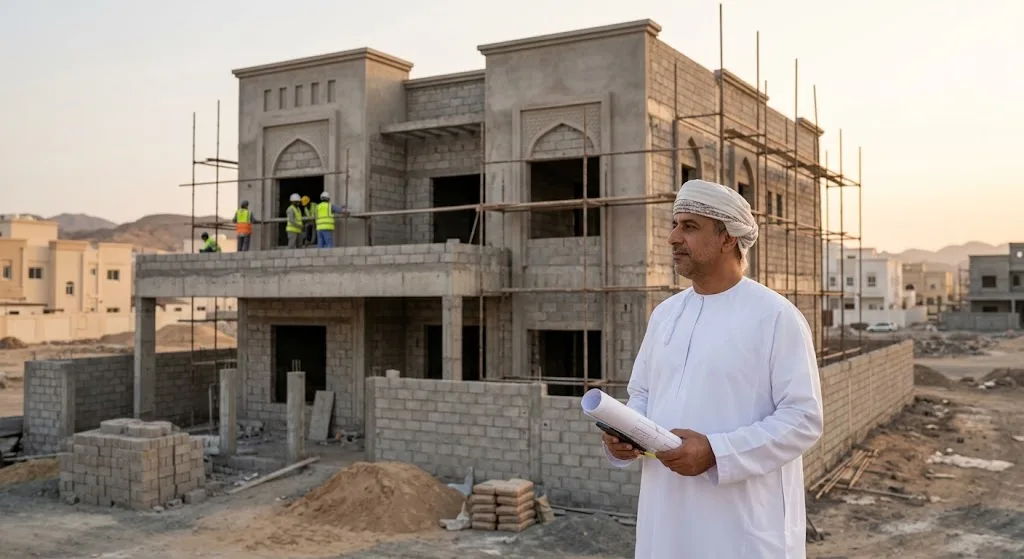
Ask what it costs to build a house in Oman and you will get numbers ranging from OMR 400 to OMR 1,000 per square metre, which is a range so wide it tells you almost nothing. The wide range is not sloppiness. It is the honest answer to a badly specified question, because "a house" covers a modest 200 sqm family villa and a marble-clad 600 sqm one, and the same contractor will quote both.
This guide does two things: gives you the bands that are actually in use, and then explains how to narrow them to a number you can plan around.
The bands in use#
| Build type | Indicative cost per sqm | 300 sqm villa, construction only |
|---|---|---|
| Rural, standard specification | Below OMR 400 | Under OMR 120,000 |
| Urban, standard specification | Around OMR 400 to 600 | OMR 120,000 to 180,000 |
| Muscat, upper specification | Around OMR 800 to 1,000 | OMR 240,000 to 300,000 |
Reported costs in upscale Muscat districts such as Bousher and Al Ghubrah have sat in the region of OMR 800 to OMR 1,000 per square metre, which anchors the top of the band. In USD terms the overall urban range works out at roughly USD 1,040 to USD 2,600 per square metre.
One piece of context worth having: Oman has been identified as one of only a small number of countries where construction costs have declined rather than risen in recent surveys, which is unusual against the global picture of the past few years. That does not make a build cheap, but it means the sharp cost escalation many buyers expect from experience elsewhere has not been the story here.
What actually moves the number#
Specification, more than anything else. The gap between the bottom and top of the range is mostly finish level, not location or contractor greed. Flooring, joinery, sanitaryware, glazing, external cladding and the amount of built-in cabinetry account for an enormous share of the difference between OMR 450 and OMR 900 per square metre. This is also the part you control, and the part that quietly inflates during the project.
Structural complexity. Level plots and simple rectangular forms are cheap. Sloping sites, split levels, long spans, basements and elaborate roof geometry are not.
Cooling and services. Air conditioning is not optional in Oman and the specification of it is a real cost decision with a long tail, because the running cost lands on you every summer for the life of the house. Under-specifying here to save on the build is a common false economy.
Landscaping and boundary work. Frequently excluded from a headline build quote and frequently forgotten in the budget. Walls, gates, driveway, external paving and planting can add a meaningful sum to a villa on a decent-sized plot.
The costs outside the build quote#
A contractor's per-square-metre figure is construction. The project is larger than that. Budget separately for:
The land. For a non-GCC foreigner this means a plot inside an ITC, and our guide to buying land in Oman as a foreigner covers who can buy what and where.
The 3% registration fee on the land purchase, paid by the buyer at title transfer.
Design and consultancy. Architect, structural and MEP engineering, and supervision during construction. Skipping proper supervision is the single most expensive saving available to you.
Permits and approvals. Construction requires formal permission and building permits from the relevant municipality and ministry, and the timeline for these is the main reason self-build projects start later than planned.
Utility connections. Water and electricity connections to a new plot are their own line item and their own process.
VAT on services. Construction and professional services are generally standard-rated at 5%, so a OMR 180,000 build carries roughly OMR 9,000 of VAT on top. Our tax guide covers how VAT treats new-build property differently depending on whether you are buying it or commissioning it.
Contingency. Ten percent is a floor, not a comfort margin.
Build versus buy#
The financial case for building is that you avoid a developer's margin, and new-build homes in Oman have been reported to sell at premiums of 15% to 30% over comparable older resale stock. Capturing part of that spread yourself is a real opportunity.
The case against is everything that is not the price. A resale purchase gives you a known number, a known condition and a key on the day of transfer. A build gives you eighteen months of decisions, a four-year clock if it is an ITC plot, and a final cost you cannot confirm until it is done. Financing is harder too: an expatriate self-build is a different proposition to a bank than a mortgage on a completed unit, and our mortgage guide sets out what lenders here typically look for.
The people for whom building genuinely works out are the ones who want something the existing stock does not offer, plan to live in it, and can absorb a delay without it breaking anything. If your reason is purely that it looks cheaper per square metre on a spreadsheet, buy resale.
How to get a real number#
The per-square-metre range in this article is a sanity check, not a budget. To turn it into one:
- Fix your built area and your specification level before asking anyone for a price. A brief that says "300 sqm, mid specification, no basement, level plot" gets you comparable quotes. "A nice villa" does not.
- Get a priced bill of quantities from at least three contractors against that same brief, so you are comparing like with like rather than comparing assumptions.
- Ask each contractor for two recently completed projects and their actual final cost against the original contract sum. The gap between those two figures tells you more about a contractor than the quote does.
- Price landscaping, boundary walls and connections as separate items so they cannot be quietly excluded.
- Add 10% contingency and treat it as spent.
If, having run that, the numbers point back towards buying rather than building, our buying process guide covers the fees end to end and the AI Property Advisor can compare finished stock against your budget.
Sources: Reported Oman construction costs of roughly USD 1,040 to USD 2,600 per square metre in urban areas, with lower figures in rural areas; reported per-square-metre costs of OMR 800 to OMR 1,000 in upscale Muscat districts including Bousher and Al Ghubrah; industry reporting identifying Oman among a small number of markets seeing construction costs decline; reported new-build premiums of 15% to 30% over comparable resale stock; Oman VAT standard rate of 5%; 3% property registration fee at Ministry of Housing and Urban Planning transfer. Build costs are project specific and the figures here are indicative bands rather than quotes, so price your own scheme with contractors before budgeting. Property figures per our methodology.