
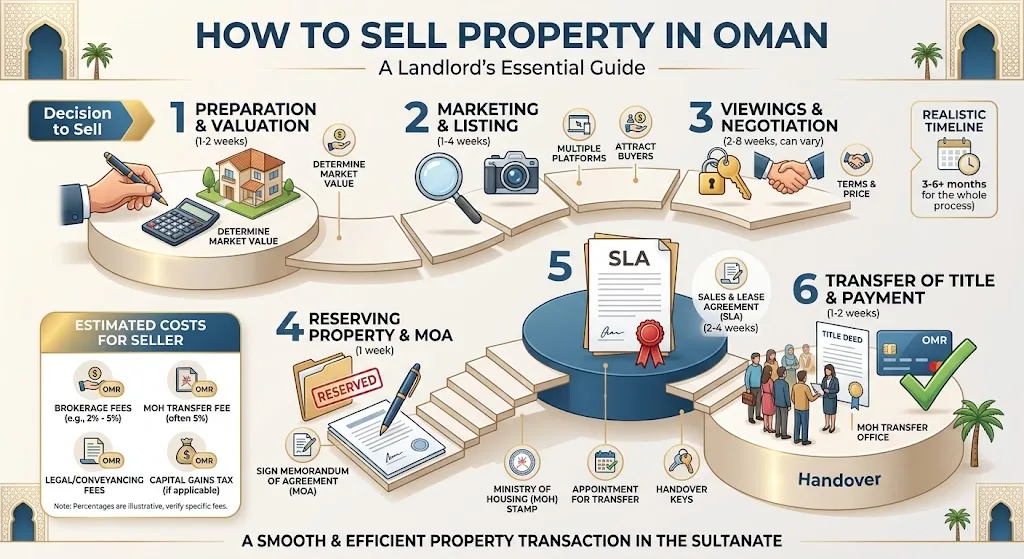
Almost everything published on Oman real estate is written for buyers. That's understandable — it's where the marketing spend is — but it leaves owners with genuinely less to go on when it's their turn to sell. Here's the process end to end, and the one thing worth understanding before you list: this is a thinner resale market than most sellers coming from Dubai or the UK expect, and pricing accordingly matters more than any staging tip.
The process, step by step#
1. Get a realistic valuation. Price against actual comparable transactions where you can find them, not just what other units in the community are currently asking — asking prices in a thin market can sit well above what's actually achieved. Our area pages carry tracked price-per-sqft figures as a starting reference point.
2. Instruct an agent, or market directly. Most sellers use an agent given the limited public transaction data in Oman's market — an agent with recent activity in your specific community has visibility into comparable sales you likely don't. Agency commission is typically around 2% of the sale price, generally paid by the seller.
3. Agree terms and sign an MOU. Once a buyer is found, a Memorandum of Understanding sets out price, deposit, and the conditions both sides are working toward before the formal Sale and Purchase Agreement.
4. Clear the mortgage, if any. If the property carries a mortgage, you'll need to obtain a discharge or No Objection Certificate from the lender, confirming the loan is cleared or will be cleared from sale proceeds at completion. This step alone can take several weeks depending on the bank — start it as soon as a buyer is confirmed, not after.
5. Check for a developer NOC requirement. On some relatively recent off-plan handovers, the original developer's transfer terms may require a No Objection Certificate before you can sell on. Confirm this at the outset of the process, not after you've already found a buyer — it's a common, avoidable source of delay.
6. Sign the Sale and Purchase Agreement. As on the buy side, having a lawyer review the SPA before signing is worth the cost, particularly around handover conditions and what happens if the buyer's financing falls through.
7. Transfer title. Both parties complete the transfer at the Ministry of Housing and Urban Planning (MOHUP), where the new Mulqiya (title deed) is issued in the buyer's name. This is also the point at which the buyer pays their registration fee — a cost the buyer bears, not the seller.
Who pays what#
| Cost | Typical rate | Paid by |
|---|---|---|
| Registration fee | 3% (foreign buyer) / 1% (Omani) | Buyer |
| Agency commission | ~2% | Seller (standard practice) |
| Mortgage discharge / NOC | Bank-dependent fee | Seller, if mortgaged |
| Developer NOC (if applicable) | Developer-dependent fee | Seller, on some recent handovers |
| Legal fees | Varies | Typically each side covers their own |
| Capital gains tax | None | N/A |
The absence of capital gains tax and any seller-side registration fee is a genuine structural advantage compared to many markets — the seller's real cost is almost entirely the agency commission and any mortgage-clearance fee, not a tax bill.
The risk sellers consistently underestimate: time-to-sale#
Oman's ITC resale market is materially thinner than Dubai's or the UK's — a smaller pool of eligible buyers (foreign nationals and Omanis, restricted by ITC status on the buy side too), less published comparable-sale data, and a market still building transaction history in most communities. That combination means realistic time-to-sale is longer than "days on market" figures from listing portals suggest, and it varies a lot by community.
Al Mouj, as Oman's most established and highest-transaction-volume ITC community, generally offers the deepest buyer pool and the fastest realistic resale of the group. Newer or lower-transaction-volume communities carry a wider, harder-to-predict range. If you're selling on a tight timeline, price toward the more conservative end of your comparable range rather than testing the top of it — our Oman vs Dubai comparison covers this liquidity gap in more depth if you're weighing it against a market you know better.
What a realistic timeline actually looks like#
A mortgage-free unit in an established, high-transaction-volume community like Al Mouj, priced against real comparable sales rather than optimistic asking prices, might see an accepted offer within two to four months of listing, followed by four to eight weeks from MOU to title transfer once the SPA is signed and MOHUP paperwork is filed — call it three to six months start to finish in a reasonably favourable case. Add a mortgage discharge into that picture and the bank's own processing time can stretch it by several weeks on its own. In a newer or lower-transaction-volume community, or with a developer NOC still outstanding, six months to a year is a more realistic planning assumption than the two-to-four-month figure above. The number that actually varies most isn't the paperwork stage — MOHUP transfer itself is comparatively fast once both sides are ready — it's the time spent finding a buyer willing to transact at a price you're prepared to accept.
What actually moves a sale#
- Price against achieved sales, not asking prices, wherever you can find them — the gap between the two is wider in a thin market than in a deep one.
- Have your paperwork ready before listing — title deed, any mortgage statement, and service charge payment history. A buyer's lawyer will ask for these, and having them ready shortens the gap between offer and signed SPA.
- Resolve any NOC requirement early, not after a buyer is found — it's the single most common cause of an otherwise-agreed sale stalling.
- Be realistic about timeline when negotiating price with a buyer under time pressure of your own — a below-market offer from a ready buyer is sometimes the better trade against an uncertain months-long wait for a better one.
If you're deciding whether to sell or hold and rent instead, our rent or buy in Muscat piece and rental yield explainer work from the other side of that decision, and the AI Property Advisor can help model both paths against your specific numbers.
Sources: MOHUP title transfer and registration process (2025-2026); agency commission norms per published Oman real estate advisory sources; capital gains and property tax treatment per Oman Tax Authority guidance; all figures cross-checked against our methodology.