
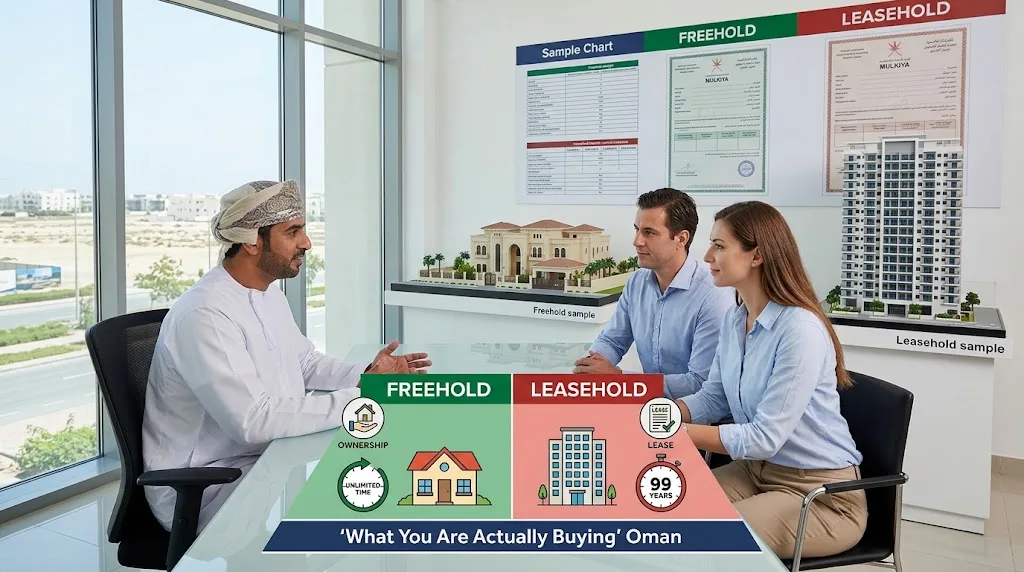
Property listings aimed at foreign buyers in Oman do not always use the words "freehold" and "leasehold" with much precision, and the two structures behave differently enough that the distinction should be one of the first questions a buyer asks, not an afterthought discovered at the title transfer stage.
What freehold actually means in Oman#
Freehold ownership is full, permanent title. It transfers on sale, passes on inheritance, and does not expire. For a non-GCC foreign buyer, freehold is only available within a specific, government-designated list of developments called Integrated Tourism Complexes, or ITCs, the framework covered in full in our expat freehold guide. Communities such as Al Mouj, Muscat Bay and Hawana Salalah sit on this list, which is why they dominate the marketing aimed at overseas buyers.
Outside a designated ITC, the general rule is that a non-GCC foreigner cannot hold freehold title to land or property. GCC nationals have separate, generally broader rights to own property across Oman, closer to those of Omani citizens.
What leasehold actually means#
Where freehold is not available, developers and landowners sometimes offer a long-term usufruct right instead, typically structured as a lease of a fixed term such as 50 or 99 years. This grants the right to use, occupy and often sublet the property for that period. It is a real, legally recognized and transferable right, not merely a rental agreement, but it differs from freehold in one important way: at the end of the term, the right reverts to the underlying landowner unless a renewal is agreed.
The practical difference this makes to an individual buyer depends heavily on the length of the term. A 99-year usufruct right functionally resembles freehold for almost any individual's holding period, since very few buyers plan to own, or expect their heirs to still hold, the same unit nearly a century later. A 25 or 50-year term is a different proposition, because the remaining term actively shrinks with every year of ownership and starts to matter for both resale value and financing well before it expires.
Where the risk concentrates#
The problem cases sit at the shorter end of the leasehold spectrum, and in developments outside the ITC list marketed to foreigners with ambiguous language about ownership. A unit advertised loosely as offering "long-term ownership rights" without specifying freehold or leasehold, or without a clear term length, deserves a direct question before any deposit changes hands.
Financing compounds the risk. Omani banks generally require a substantial remaining lease term, commonly at least 25 to 30 years beyond the loan's own repayment period, before they will mortgage a leasehold unit, a detail worth checking early against our mortgage guide. A leasehold property with a shrinking remaining term becomes progressively harder to mortgage and, as a direct consequence, harder to resell to the next buyer, who faces the same financing constraint.
How to actually check before you buy#
Ask directly, in writing, whether the specific unit is freehold or leasehold, and if leasehold, the exact remaining term in years. Request the title or usufruct deed reference rather than accepting marketing material or a verbal assurance from an agent, since the legal structure is what a lawyer or bank will ultimately rely on, not the brochure. And independently confirm the development's status against the Ministry of Housing and Urban Planning's list of approved Integrated Tourism Complexes rather than trusting a developer's own claim to ITC status, since this is exactly the kind of detail worth an hour of verification against a five or six-figure purchase.
Our buying process guide and the common pitfalls in our mistakes guide both cover the surrounding due diligence steps this question sits inside.
What to do with this#
Treat "freehold or leasehold, and if leasehold what term" as a standard first question for any unit marketed to you as a foreign buyer, not a detail to leave for the lawyer to discover during conveyancing. A 99-year usufruct right in a strong location at a fair price is not automatically a bad investment, but a shorter or vaguely specified term should be priced and financed accordingly, and confirmed against official ITC status before you commit.
Use the AI Property Advisor to check a specific community's ownership status against your budget, or work through the numbers with our mortgage calculator once you know the actual title structure.
Sources: Oman Foreign Capital Investment Law and Integrated Tourism Complex ownership framework; Ministry of Housing and Urban Planning list of approved ITC developments; standard Omani bank lending criteria on minimum remaining leasehold term. Ownership structures vary by individual development and unit, so confirm the specific title or usufruct deed for any property directly with the developer and a licensed lawyer before purchase. Property figures per our methodology.