
Almost every guide to buying property in Oman answers the apartment question and stops. Land is a genuinely different question, with a different answer depending on your passport, and it is the one people get wrong most often after arriving from markets where a plot and a flat are treated the same way.
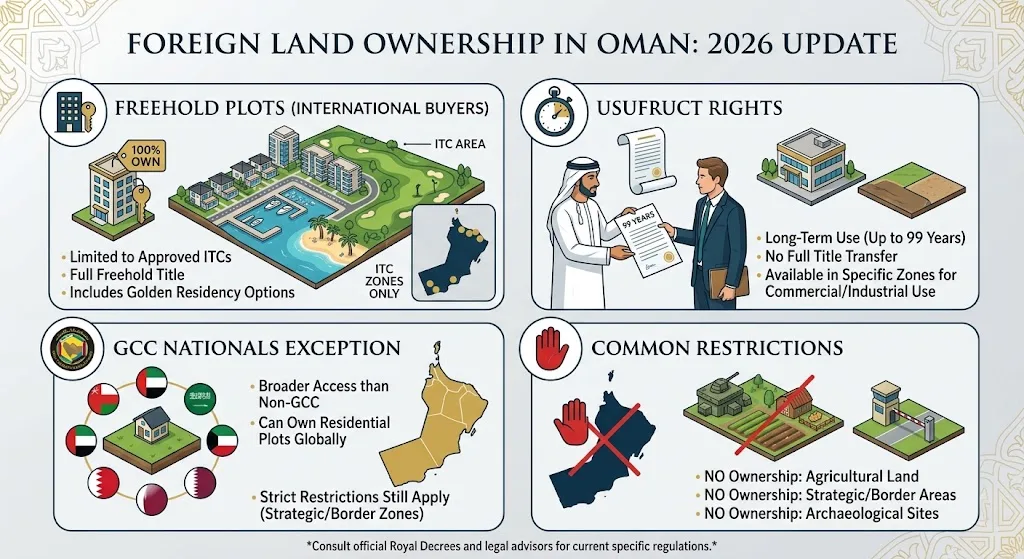
The short version: a non-GCC foreigner can own land in Oman, but only inside an Integrated Tourism Complex. Everywhere else, what is available is a usufruct right rather than title. A GCC national faces neither restriction.
Three different positions, one country#
| Buyer | Land inside an ITC | Land outside an ITC |
|---|---|---|
| Omani national | Yes | Yes |
| GCC national or wholly GCC-owned company | Yes | Yes, treated in line with Omani nationals under Royal Decree 21/2004 |
| Non-GCC foreigner | Yes, 100% freehold on residential and commercial plots | No freehold title; usufruct or leasehold up to 99 years |
This table is the whole article in miniature, but each row has a catch worth understanding.
Freehold plots inside ITCs#
Inside a licensed ITC, a non-GCC foreigner can own a plot outright, in the same way they can own a built villa or apartment. The national list of ITC communities is short and well known: Al Mouj, Muscat Bay, Muscat Hills, Jebel Sifah, AIDA at Yiti and Hawana Salalah among them.
Two things follow that do not apply to buying a finished unit.
The build obligation. ITC land generally comes with a requirement to build within four years. The Ministry of Housing and Urban Planning can extend that where circumstances justify it, but undeveloped land past the deadline can be reclaimed and auctioned. That single term reshapes the investment case: an ITC plot is not a passive land-banking instrument, it is a commitment to a construction project on a clock.
Build cost dominates the budget. The plot is the smaller and more predictable half of the spend. Our guide to the cost of building a house in Oman covers the range and, more usefully, how to get a real number for a specific plot rather than a national average.
Usufruct: what it actually gives you#
Outside ITC zones, the instrument available to expatriates is usufruct, a registered right to use and benefit from a property for a fixed term of up to 99 years without owning the land. Ministerial Decision 357/2020 opened this to expatriates who have been resident in Oman for at least two years, in approved buildings.
It is worth being precise about what this is, because it gets described at both extremes.
It is not a tenancy. A usufruct is a registrable property right with a long term, and it is a real interest in the property rather than a contractual permission to occupy.
It is also not freehold. The term is finite, the land beneath is not yours, and the value of the right declines as the remaining term shortens, which matters on resale in a way that freehold value does not. A 99-year right sold with 60 years left is a different asset from the one originally granted.
For a self-occupier who wants to live outside the ITC bubble in a normal Muscat neighbourhood, that trade can make sense. For an investor underwriting a long-term hold and exit, the shortening term is a variable that needs to be in the model.
The GCC exception#
Under Royal Decree 21/2004, GCC nationals and wholly GCC-owned companies are treated in line with Omani nationals for acquiring real estate. In practice this means a Saudi, Emirati, Qatari, Bahraini or Kuwaiti buyer is not confined to the ITC list and can look at land across the country.
That is a materially wider opportunity set than a European or Indian buyer has, and it is a large part of why regional capital behaves differently in Oman's market than international capital does. Our GCC investment overview covers where that money has actually gone, and the Oman versus Saudi and Bahrain comparison sets the returns side by side. Conditions attached to specific plots still apply, so verify the position on a particular parcel rather than assuming blanket access.
Practical steps before you commit to a plot#
Confirm the zone in writing. ITC status is the thing that makes freehold possible, and it should be evidenced by documentation confirming the plot sits inside an approved ITC, not by a salesperson's assurance.
Read the build clause first. Four years sounds generous until you have gone through design, permits and contractor selection. Ask what an extension actually requires and how often the developer has seen one granted.
Price the permit path. Construction requires formal permission and building permits from the relevant municipality and ministry. Get a realistic timeline from someone who has recently completed the process in that specific community, not a general estimate.
Budget the 3% registration fee. It applies at title transfer on land as on a built unit, and it is a buyer cost.
Get legal review before signing. Plot purchases carry conditions that finished-unit purchases do not, and this is not the place to economise. Our list of common mistakes foreign buyers make covers what goes wrong when this step is skipped.
Is a plot the right move at all?#
For most foreign buyers, honestly, no. A finished unit in an established ITC community carries a known price, a known service charge and a resale market with some transaction history behind it. A plot carries a build project, a permit process, a four-year clock and a final cost you will not know precisely until it is finished.
The case for a plot is strongest when you want something specific that the existing stock does not offer and you are going to live in it. It is weakest when the plan is to hold vacant land and sell it on, which is the plan the build obligation is specifically designed to prevent.
If a finished unit is the more realistic route, compare communities through our area pages or run a target budget through the AI Property Advisor.
Sources: Integrated Tourism Complex freehold framework under Royal Decree 12/2006; GCC national parity for real estate acquisition under Royal Decree 21/2004; expatriate usufruct rights of up to 99 years in approved buildings under Ministerial Decision 357/2020; four-year build requirement on ITC land with extension at the discretion of the Ministry of Housing and Urban Planning; 3% registration fee at title transfer. Regulations in this area have changed repeatedly in recent years, including the 2026 registry law changes, so confirm the current position with a qualified Omani lawyer before committing to a plot. Area figures per our methodology.