
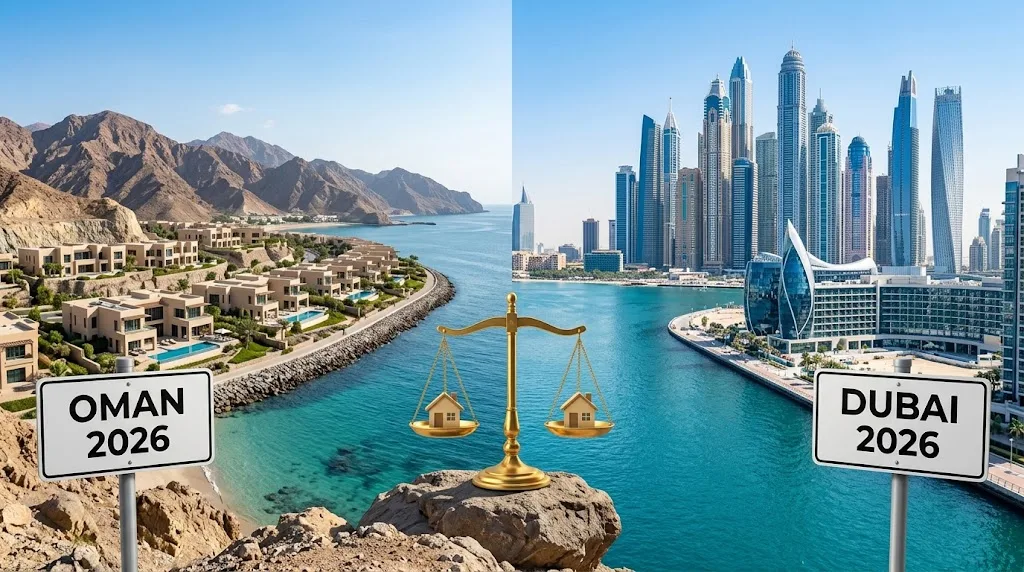
The comparison most people are actually making isn't Oman against Dubai in the abstract — it's "I know Dubai, should I look at Oman instead?" Almost all the content answering that question is written by parties selling one of the two markets.
Here's the side-by-side with the awkward parts left in, including the places where Oman is not the cheaper option.
The headline table#
| Dubai | Oman (Muscat) | |
|---|---|---|
| Average price/sqft | ~AED 1,916 (~OMR 200) | OMR 60–140 by area |
| Typical apartment yield | 6–8.5% | 5.2–7.5% tracked, but see below |
| Foreign ownership | Designated freehold areas, broad coverage | Licensed ITC zones only, narrow coverage |
| Transfer fee | 4% (Dubai Land Department) | ~3% (registration) |
| Total buying costs | ~6–8% | ~5% |
| Annual property tax | None | None |
| Capital gains tax | None | None |
| Residency threshold | AED 2,000,000 → 10 years | OMR 250,000 → 5 years; OMR 500,000 → 10 years |
| Market data availability | Extensive, official, transaction-level | Limited; official index quarterly, no open price feed |
| Resale liquidity | Deep | Thin |
Dubai figures reflect our mid-2026 Dubai market analysis; Oman figures are the ones published on our own area pages, compiled per our methodology.
Where Oman genuinely wins#
Entry price. This is the real gap. Al Mouj, the most expensive area we track in Muscat, sits at OMR 140/sqft — roughly 30% below Dubai's citywide average, and well under half what Dubai's own waterfront communities command. Mid-market Muscat at OMR 71–100/sqft is a different price universe from anything comparable in Dubai.
Total acquisition cost. Oman's ~5% all-in is meaningfully below Dubai's ~6–8%, driven mostly by the 3% registration fee against Dubai's 4% Land Department transfer fee. On a round trip that difference compounds.
Market stage. Oman's official NCSI index rose 15.9% year-on-year in Q1 2026, with Muscat residential land up 43.6% — the sharpest governorate move nationally. That's an earlier-stage market with more room in it, if you believe the diversification story behind Vision 2040 plays out.
Regulatory momentum. Two 2026 changes went the right way for foreign buyers: the new Real Estate Registry Law and a sponsor-free owner's residence permit. We cover both in what actually changed in 2026.
Where Oman genuinely loses#
Choice. This is the one that gets glossed over. In Dubai, designated freehold areas cover a large share of the city's residential stock. In Oman, a foreign buyer is limited to licensed Integrated Tourism Complexes — in Muscat, effectively Al Mouj, Muscat Hills, Muscat Bay, Jebel Sifah and AIDA at Yiti, plus Hawana Salalah on the south coast.
That's a handful of developments, not a market. Everything below follows from it.
The yields you can actually access. Oman's best tracked yields — an estimated 7.5% in Al Khuwair and Al Khoud — sit in non-ITC areas closed to foreign purchase. The freehold-eligible communities run an estimated 5.2% (Al Mouj) to 7.0% (Muscat Bay). Compare that band against Dubai's 6–8.5% and the yield advantage largely disappears.
Liquidity. A Dubai Marina apartment has a continuous, deep buyer pool. An ITC unit in Muscat has a narrow one — foreign buyers eligible under the same restriction that got you in, plus a limited domestic luxury market. Time-to-sale is the risk most consistently understated in Omani off-plan marketing, and it's the reason a short holding period is riskier here than the price gap suggests.
Data. Dubai publishes transaction-level records. Oman publishes a quarterly NCSI index and, through the Ministry of Housing and Urban Planning, sale-contract registration counts — 9,366 for Muscat governorate over Jan–Sep 2025, 73% of them land — but no open price feed at unit level. We built this site partly because that gap exists; it's still a gap.
The residency threshold, which is not cheaper. This one surprises people. Dubai's Golden Visa requires AED 2,000,000 in unencumbered freehold property for 10 years. Oman's OMR 250,000 entry tier converts to roughly AED 2.4 million at current rates — for a 5-year permit. Oman's 10-year tier at OMR 500,000 is roughly AED 4.8 million. On residency-by-investment specifically, Dubai is the cheaper market, and any content telling you otherwise hasn't done the conversion. Full detail in our golden visa guide.
The comparison nobody frames correctly#
The useful question isn't "which market is better." It's which risk are you being paid to take.
In Dubai you're buying a liquid, well-documented, competitive market at a mature price. Your return comes from picking well inside a market where information is cheap and everyone else has it too.
In Oman you're buying an illiquid, thinly-documented market at an early price, with a restricted menu. Your return comes from the market re-rating over a long hold — and you're accepting that you may not be able to exit quickly if it doesn't.
Those are different trades. The second one is defensible with a 7–10 year horizon and indefensible with a 3-year one, which is roughly the opposite of how "Oman is cheaper than Dubai" content usually positions it.
If you're seriously considering Oman#
Three checks worth doing before anything else:
- Verify ITC licensing in writing. "Freehold" is used loosely in marketing. ITC status is a legal designation under Royal Decree 12/2006, and it's what actually confers ownership and residency eligibility.
- Model the exit, not just the entry. Assume a longer time-to-sale than you would in Dubai, and check the numbers still work.
- Price the service charges. Premium ITC communities carry annual charges that materially affect net yield, and they're rarely in the headline pitch.
Run the numbers with our yield calculator, compare areas directly in the comparison tool, and read the current state of the market in our Oman market report.
Sources: Dubai price-per-sqft and yield figures from our mid-2026 Dubai market analysis; Dubai Land Department fee schedule; NCSI Real Estate Price Index Q1 2026; Ministry of Housing and Urban Planning sale-contract registration open data (Jan–Sep 2025); Oman price and yield figures from our own area dataset. Currency conversions at 2026 rates — OMR/AED is effectively fixed via both currencies' USD pegs, but confirm before budgeting.