
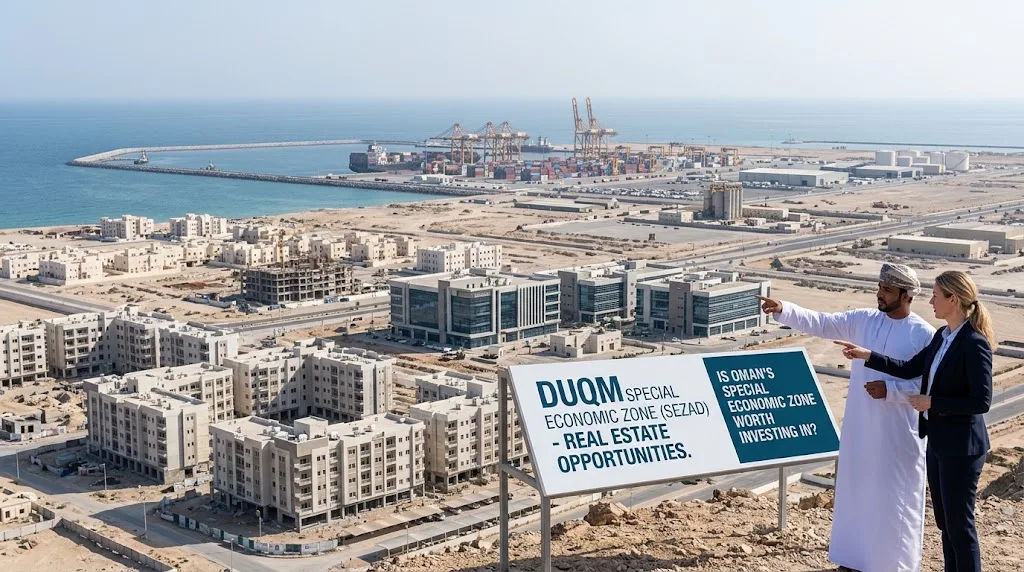
Most conversations about buying property in Oman start and end with Muscat, and for good reason. But roughly 550 km south of the capital, on a stretch of coastline outside the Strait of Hormuz, Oman has built something structurally different from anything in the freehold guides: a 2,000 sq km special economic zone where the ownership rules, tax treatment and entire investment logic are not the same as the rest of the country. This is what Duqm actually is, and what buying into it means.
What SEZAD actually is#
The Special Economic Zone at Duqm, known as SEZAD, is not a tourism development like Hawana Salalah or a residential masterplan like Madinat Sultan Qaboos. It is an industrial and logistics zone built around a deep-water port and dry dock, with a working oil refinery, a planned petrochemical cluster, fisheries and food processing zones, and its own airport. Residential and tourism development sits alongside that industrial core, built to house the workforce the port and refinery bring in and to give the zone a coastal leisure offering of its own.
The strategic logic is location. Duqm sits south of the Strait of Hormuz, so cargo and shipping routed through it avoids the chokepoint that Gulf ports inside the Strait cannot. That single fact underpins a meaningful share of the investment case for the port, the refinery and everything built to serve them.
Why the ownership rules are different here#
Under Oman's general framework, a non-GCC foreign buyer can only own freehold property inside a designated Integrated Tourism Complex, the model covered in our freehold guide. SEZAD runs on its own investment law instead, and that law permits 100% foreign ownership of land and property within the zone without the ITC designation requirement. In practice this means the ownership gate that shapes every other buying decision in Oman does not apply the same way inside Duqm's boundary.
That comes with a trade-off worth being honest about. The ITC system exists in mature, tested developments with resale markets, management companies and years of price history. Duqm's residential and mixed-use schemes are newer, smaller in number, and the resale and rental liquidity that exists in Al Mouj or Qurum simply has not built up yet.
The tax and business incentives#
For an investor buying to operate a business within the zone rather than a single residential unit, SEZAD's incentives are substantial: up to 30 years of corporate tax exemption for qualifying activities, no customs duty on goods moving through the zone, and unrestricted repatriation of profits and capital. These sit on top of, not instead of, Oman's already favorable personal tax position of no income tax, no capital gains tax and no annual property tax, detailed in our tax guide.
For a buyer purchasing residential property purely as a home or a rental unit rather than to run a business, these corporate incentives are largely irrelevant. The property-level tax treatment, such as the 3% municipality tax on rental income, follows the same national rules as anywhere else in Oman.
What is actually driving demand#
Three projects do most of the work. The Port of Duqm and its dry dock, one of the largest in the region, anchor shipping and maritime services employment. The Duqm Refinery, a joint venture between Oman and Kuwait, brings a large permanent industrial workforce and its associated contractor ecosystem. Duqm International Airport, upgraded to support the zone's growth, connects the area without routing everyone through Muscat first.
Each of these is a multi-year, capital-intensive project, and the honest read is that Duqm's residential and property market grows in step with them rather than ahead of them. That is a different risk profile from buying an already-occupied building in central Muscat.
The case for and against#
The case for Duqm rests on entry pricing below comparable coastal Muscat stock, genuinely unrestricted foreign ownership without the ITC constraint, and a multi-decade national infrastructure commitment that is already built rather than merely announced, since the port and refinery are operational. The case against rests on thinner liquidity if you need to exit, a market with limited transaction history to price against, and demand that depends on continued industrial buildout rather than tourism or lifestyle pull, the driver behind most of the rest of Oman's residential market covered in our best areas to invest guide.
Duqm is not a like-for-like alternative to Muscat, and treating it as one is the most common mistake. It is closer to an early-stage bet on a specific industrial corridor, priced and structured accordingly.
What to do with this#
If you are drawn to Duqm, underwrite it against the pace of the port, refinery and airport buildout rather than against comparable Muscat yields, since the two markets are not driven by the same demand. Confirm the specific ownership structure and zone boundary for any unit you look at directly with the master developer, since SEZAD's 100% foreign ownership applies within the zone rather than automatically across the wider Al Wusta region. And compare it honestly against the established, more liquid options in our best areas to invest guide before deciding which risk profile actually fits your goals.
Use the AI Property Advisor to weigh a Duqm opportunity against comparable Muscat and Salalah options for your specific budget and timeline.
Sources: Special Economic Zone Authority at Duqm (SEZAD) investment law and foreign ownership provisions; Duqm Refinery joint venture structure; Port of Duqm and dry dock development status. Figures and zone boundaries can change as SEZAD's masterplan evolves, so confirm specifics for any unit directly with the developer and SEZAD before committing. Property figures per our methodology.