
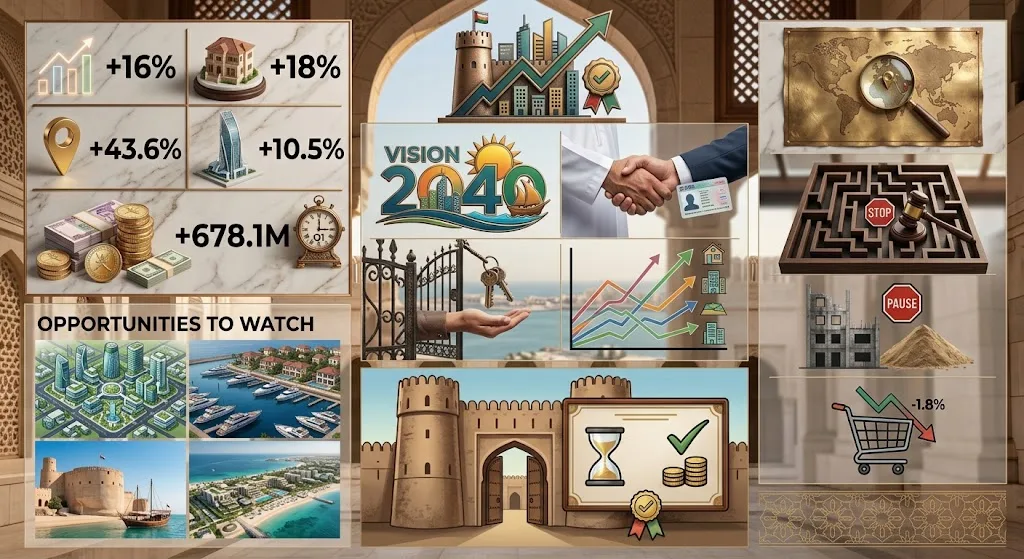
Every "is Oman a good investment" article online is written by someone selling you an Oman property. This one isn't — it's the numbers, the genuine strengths, and the practical details worth knowing before you buy.
The case for it#
Yields are genuinely competitive. Across the areas we track, gross rental yields range from 5.2% to 8.85% — comparable to, and in several areas better than, mature GCC markets like Dubai, where apartment yields commonly sit in the 6–8.5% band. Al Khuwair and Al Khoud in Muscat, and Sohar City Centre, all track above 7.5%.
There's no annual property tax and no capital gains tax on residential property, which is not universal even within the region.
Price growth has been real without looking speculative. Oman's NCSI Real Estate Price Index rose 15.9% year-on-year in Q1 2026 — but broken down, apartment prices rose a much steadier 4.4%, while the headline figure was pulled up by land transactions. A market where built-unit prices move in the mid-single digits and land speculation is a separate, identifiable component is a healthier pattern than one where everything is running hot together. We cover this split in detail in our Q1 2026 price index analysis.
Entry prices are low relative to comparable coastal markets. Waterfront units in Oman's ITC communities start from roughly OMR 600–1,000/sqm in several developments — a fraction of equivalent beachfront pricing in Dubai.
Ownership comes with a residency path. A property purchase of OMR 250,000 or more qualifies for a renewable 5-year residence visa, and OMR 500,000+ for 10 years — no minimum-investment-fund structure required, unlike some competing jurisdictions. Our Golden Visa guide covers the thresholds and process.
What to plan around#
Foreign ownership runs through a defined, well-established route. Under Royal Decree 12/2006, non-Omanis buy freehold inside licensed Integrated Tourism Complexes — Al Mouj, Muscat Hills, Muscat Bay, Jebel Sifah, AIDA at Yiti, and Hawana Salalah, among others. These are also some of the country's best-positioned coastal and marina developments, purpose-built with foreign buyers in mind. Our expat freehold guide has the full zone list.
This is a buy-and-hold market. Resale volumes in Oman's ITC communities are still building compared with Dubai or comparable established markets, which suits an investor planning to hold for the medium-to-long term and collect yield along the way, rather than one planning a fast flip.
Factor service charges into your net yield. ITC communities carry an annual service charge, commonly OMR 3–8 per square metre, that funds shared amenities like marina and beach maintenance. It's a normal cost of owning in a well-maintained resort community — just net it out of the headline gross yield figures above to get your real return.
Market data is improving. The official NCSI index is quarterly and includes land transactions alongside built units, so it's worth cross-checking a specific listing against tracked, area-level data rather than the index alone — exactly what we publish on each area page.
What the numbers actually say, area by area#
| Area | Price/sqft | Gross yield est. | Foreign freehold? |
|---|---|---|---|
| Al Mouj | OMR 140 | 5.2% | Yes |
| Muscat Hills | OMR 110 | 6.2% | Yes |
| Muscat Bay | OMR 100 | 7.0% | Yes |
| Hawana Salalah | OMR 144 | 6.5% | Yes |
| Al Khuwair | OMR 81 | 7.5% | No |
| Al Khoud | OMR 60 | 7.5% | No |
| Sohar City Centre | OMR 42 | 8.85% | No |
Figures are the ones published on each area page on this site, per our methodology. Every one of the foreign-eligible areas above yields upwards of 5%, with several clearing 6.5-7% — a genuinely strong range for freehold coastal property, and the non-eligible areas at the bottom simply confirm that Oman's rental market is healthy well beyond the ITC zones too.
Our honest read#
Oman is a strong fit for a buyer who wants genuine GCC coastal freehold exposure at a lower entry price than Dubai, likes the idea of holding for the medium-to-long term and compounding yield along the way, and wants the residency benefits that come with an ITC purchase. It suits patient capital better than a fast trade — worth knowing going in, not a reason to hold back.
Run your own numbers to see the full picture — our yield calculator factors in registration fees and service charges, not just the headline rent, and the AI Property Advisor can match a budget against the areas above.
Sources: NCSI Real Estate Price Index Q1 2026; price-per-sqft and yield figures from our own tracked area dataset, per our methodology; ITC/freehold status per published Integrated Tourism Complex zone lists.