
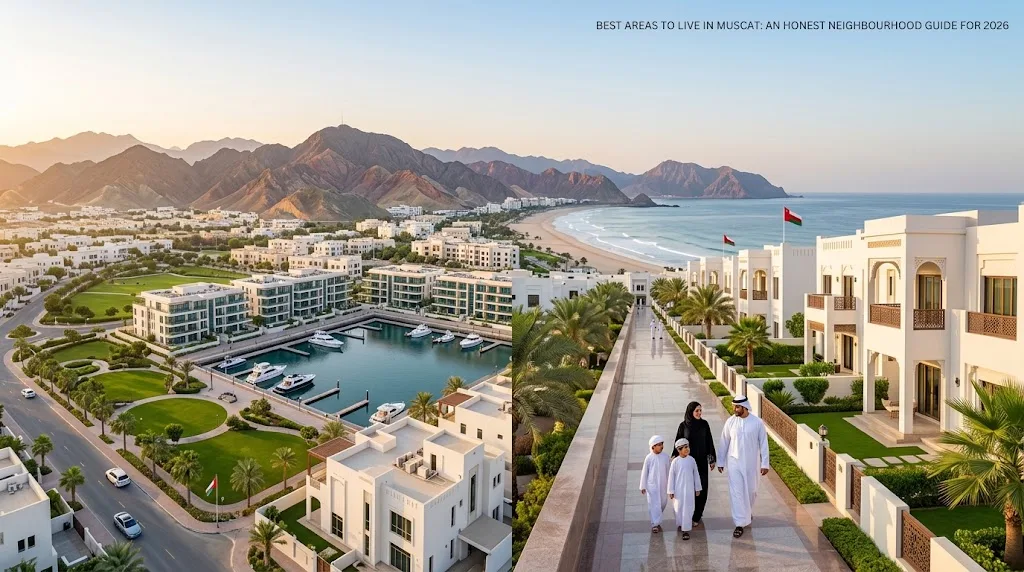
Most "best areas in Muscat" guides describe neighbourhoods with adjectives. This one uses the same price, yield and rent figures published on our area pages, so you can see what each district actually costs before deciding whether the adjectives are worth it.
The short version: Al Mouj if budget isn't the constraint and you want the waterfront expat community. Madinat Sultan Qaboos or Qurum for families who want school access and a central location. Al Khuwair or Al Ghubrah for the best cost-to-convenience ratio in the city. Al Khoud if price is the deciding factor.
The whole city, on one table#
| Area | Price/sqft | Est. gross yield | Foreign purchase | Best suited to |
|---|---|---|---|---|
| Al Mouj | OMR 140 | 5.2% | Yes (ITC) | Expat professionals, families, lifestyle buyers |
| Muscat Hills | OMR 110 | 6.2% | Yes (ITC) | Corporate tenants, golf, airport proximity |
| Muscat Bay | OMR 100 | 7.0% | Yes (ITC) | Ultra-luxury, limited supply |
| Madinat Sultan Qaboos | OMR 100 | 5.5% | No | Expat families, schools |
| Qurum | OMR 98 | 6.0% | No | Families, central living, beach access |
| Azaiba | OMR 81 | 6.0% | No | Airport-adjacent, corporate housing |
| Al Khuwair | OMR 81 | 7.5% | No | Professionals, ministries, value |
| Al Ghubrah | OMR 71 | 7.0% | No | Mid-income professionals, central value |
| Al Khoud | OMR 60 | 7.5% | No | Budget renters, students |
Two things fall out of this table immediately, and both run against how these areas are usually sold.
First: living quality and investment quality point in opposite directions. The most desirable addresses yield the least. Al Mouj commands the highest rent in Muscat and returns an estimated 5.2%, because its sale prices have outrun its rents further than anywhere else. Al Khuwair, with none of the waterfront appeal, returns an estimated 7.5% on a price per square foot 42% lower.
Second: the highest-yielding areas are closed to foreign buyers. Under Royal Decree 12/2006, non-Omanis can only buy inside a licensed Integrated Tourism Complex. That's the "Yes (ITC)" column — three areas, all in the top half of the price table. The 7.5% yields are real and they are not available to you if you hold a foreign passport. Our freehold and ITC guide covers this in full.
The premium tier#
Al Mouj Muscat#
The default answer for expats, and reasonably so. Oman's flagship freehold waterfront ITC: a marina, beach access, a golf course, a walkable retail and dining strip, and the largest single concentration of expat residents in the country. Two-bedroom rents run around OMR 710 a month, the top of the citywide range.
The honest trade-offs: it's the most expensive place to live or buy in Muscat, the estimated yield is the lowest of any area we track, and it sits west of the central districts — closer to the airport than to the Qurum school cluster.
Muscat Hills#
A golf-course ITC community roughly 5km from Muscat International Airport, which is exactly why it does well with corporate tenants and short-to-medium-term company housing. Two-bedrooms around OMR 490. At OMR 110/sqft with an estimated 6.2% yield, it's the best balance of freehold eligibility and yield among the ITC options.
Muscat Bay#
Ultra-luxury, deliberately limited supply, built around a private lagoon near Qantab. Not a volume market — this is a small number of high-value units and a resale pool to match. Worth understanding as a distinct product rather than a more expensive version of the others. Detail on the Muscat Bay project page.
The family tier#
Madinat Sultan Qaboos (MSQ)#
The most consistently recommended district for expat families, and the reason is unglamorous: schools, supermarkets, clinics and parks are all within a short drive, and the commute into the central business areas is manageable. At OMR 100/sqft it prices close to Qurum without the beachfront premium. An estimated 5.5% yield reflects that this is a place people live rather than a place people flip.
Qurum and Shatti Al Qurum#
Central, beach access, embassies, and the densest cluster of international schools and restaurants in the city. Two-bedrooms run OMR 350–500 depending on how close to the water you get. At OMR 98/sqft and an estimated 6.0% yield, it's the strongest all-round combination of location and value in the non-ITC market — with the smallest off-plan share of any area we track (10%), which tells you it's an established, built-out district rather than a development story.
The value tier#
Al Khuwair#
The workhorse of Muscat's rental market. Dense, central, surrounded by ministries and offices, with a tenant pool that refills quickly. Two-bedrooms run OMR 220–475 — the widest band of any area here, because the stock ranges from tired 1990s blocks to recent builds. At an estimated 7.5% gross yield on OMR 81/sqft, it's the best-returning area we track in Muscat.
Al Ghubrah#
Central, practical, mid-income. Slightly cheaper than Al Khuwair at OMR 71/sqft with an estimated 7.0% yield, and a similar profile — good tenant demand, unremarkable buildings, no lifestyle premium in the price.
Azaiba#
Between Al Ghubrah and the airport, drawing corporate tenants and business travellers. OMR 81/sqft, estimated 6.0% yield. Notable for sitting on the proposed metro corridor, which is a long-horizon consideration rather than a current amenity.
Al Khoud#
The budget end, out along the Seeb corridor near Sultan Qaboos University. OMR 60/sqft — 57% below Al Mouj — with an estimated 7.5% yield and the highest off-plan share of any Muscat area we track at 40%, reflecting active new development. The caveat that comes with cheap stock everywhere applies: inspect for maintenance, water and lift issues rather than judging on price.
What's coming, and why it matters#
Two developments will reshape the western corridor over the next decade, and both are worth factoring into a long-horizon decision:
- Sultan Haitham City in Al Seeb — around 20,000 homes for roughly 100,000 residents across 14.8 km². The largest single addition of housing supply in the country's history, and the main reason the Bawshar and Seeb corridors are watched for appreciation.
- Madinat Al Irfan — OMRAN's mixed-use district near the airport and convention centre.
New supply at that scale cuts both ways. It's a strong signal for land and infrastructure value in the west, and a genuine question mark over rental pricing power in the mid-market once units start delivering.
How to actually choose#
Rank these four in the order that matters to you, and the answer usually falls out:
- School commute — if you have children in international school, this constrains everything else. Start with MSQ and Qurum.
- Work commute — Muscat is linear, and crossing the city twice daily is the most common regret from people who chose on price.
- Buy or rent — if you're buying as a foreigner, only three Muscat areas are open to you, and the decision narrows dramatically.
- Budget — the citywide two-bedroom range runs OMR 300 to OMR 710. That's the same apartment in a different postcode.
Every area above has a page on this site with its full price history, amenity distances, off-plan share and sourcing — start at Muscat. If you'd rather work backwards from a budget, the AI Property Advisor matches against the same data, and the comparison tool puts any two areas side by side.
Sources: price-per-sqft, yield and off-plan figures from our own Muscat area dataset (see methodology); our Muscat neighbourhood and rent analysis (updated April and July 2026); Royal Decree 12/2006 on Integrated Tourism Complexes.